
Ikigai- The art of staying young while growing old
Have you ever wondered why people who are physically fit, who are very conscious on their diet too, die very early. I was thinking on these same lines for a long time. This book finally gave me the answer.
We think Longevity is just associated only with physical fitness. But it has got a lot to do with the other aspects of life. This book will help you, in not only learning the art of longevity but also pave a path to find the love of your life-your passion. Every chapter of this book gives you little nuggets to lead a happy and healthy life. I highly recommend you to buy this book and I bet this book will definitely change your perspective towards life.
What is Ikigai?
Ikigai is the art of staying young, while growing old. It is the reason we wake up in the morning. In simple words it is the reason you live for.Having a clear defined ikigai brings happiness,satisfaction and meaning to your lives.
The Japanese island of Okinawa, where ikigai has its origins, is said to be home to the largest population of centenarians in the world. I watched a documentary in YouTube on the island of Okinawa and I was fascinated to see people even at the age of 100, were able to walk normally, dance their heart, socialize with their friends and most importantly they were happy beyond words.
When we have only seen people, who cannot even get up from bed at the age of 80, and perform their daily tasks but this was truly amazing to watch. Another surprising thing is people living in Japan, never retire. They keep doing what they love for life.
The striking feature of this book is the moment you open the first chapter they give you their secret of longevity.
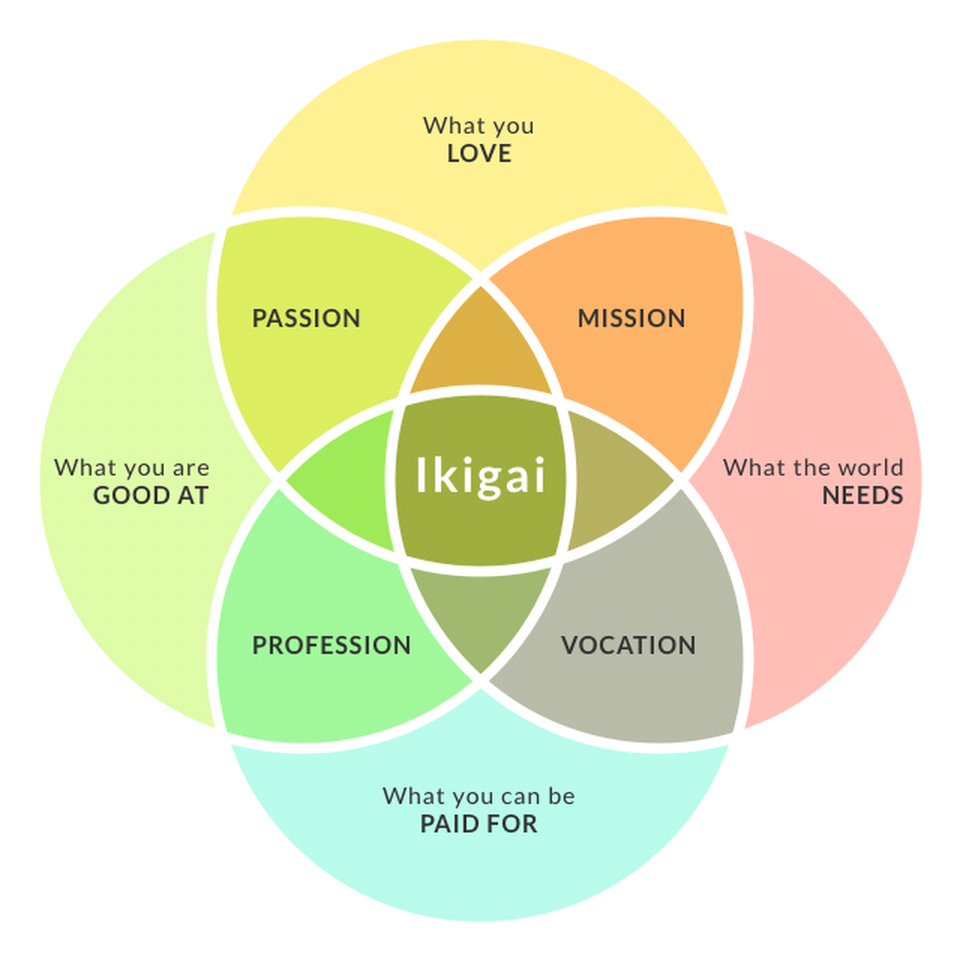
When you read this book, keep a journal or notebook handy. This will help you figure out a lot about yourself. The first chapter opens with the basic question. What is Ikigai and how to find your Ikigai.
Answering the four questions below will help you take the first baby step towards longevity.
1.What you love?
2.What you are Good at?
3.What the world needs?
4.What you can be paid for?
PASSION
Once you have jotted down the answers, for what you love and what you are good at, look out for the answers that are common in both the questions. That is going to be your passion. We should note that “What you are good at” is where you have to create a list of things you can accomplish in significantly less time without investing a lot of effort. It is like something that you are naturally good at, than others.
For example,
What I love is blogging,singing, reading books, fitness, traveling,fashion designing, terrace gardening, preparing bioenzymes, teaching children and painting. But What I am good at is blogging, painting and teaching children. I am working on improving my other areas of interest. So the three skills I have mentioned, is something I can accomplish in significantly less time. So this is my passion.
MISSION
See what you love is what the world needs. For example, I love blogging and the world too needs a lot of bloggers. So this is my mission.
VOCATION
This world needs a lot of bloggers, but can I be paid for it? Yes I can be paid for my writing skills. Vocation is a strong feel of suitability to a particular occupation. So my vocation is blogging.
PROFESSION
Now we have to see what we are good at and what we can be paid for? Say for example, I love fashion designing, but I do not know to design. So I cannot be paid for it. This way, you can find your profession. So now I love blogging, painting and teaching children. I can be paid for all of the above. Hence this forms my profession.
IKIGAI
See what intersects in the answers for all four questions. There we have arrived at finding our happiness, our passion and this is something that is going to help us stay young. To me, it is blogging. I loose myself when I start writing and though I invest a lot of time, it rejuvenates me. Hence my Ikigai is BLOGGING.
Now what’s stopping you. Start pursuing your Ikigai and you are going to be happy for life. It will take sometime to complete this exercise. Stay patient. Get inputs from you family members and friends about say your best qualities,if you are unable to figure it out by yourself. You can also get necessary inputs from your life experiences. They act as a best guide, because you would have pursued something very passionately with josh but later you would have figured out, it doesn’t work best for you. So take some time to answer all the questions as this process is going to change your life.
Whatever you do, do not retire
In the hustle bustle of this world, we wake up to the call of our phone alarm and before even we realize it is morning, we have to run to the kitchen and cook, then get the children ready to school and rush to office in the long standing never moving ever stressing traffic. Once we reach the office, before we sit and take a deep breath we have to attend meetings, complete tasks before the deadline, have deliberate patience in trying to explain things to clients and co workers, though it is like sitting on a seat and working, it always seems like we are sitting on a SATI fire(facing the heat,right). Then after a tiresome day, when we return home, there we have all the household chores that requires immediate attention, winking at us. Once you complete everything, help children with homework, have dinner and when you reach the bed and before even you can think, if it was a happy day,did you do something for yourself,you sleep…. The same routine, when it continues for years , you feel someday you have to runaway from this stress and you eagerly start awaiting the day of retirement.

We feel if we don’t retire and continue facing the same stress for years, we are going to die because of it.
But the most surprising thing about Japanese culture is they don’t retire.They say, when you have a purpose in life, that you love, that you are awaiting every morning with love to start working on it, you enjoy every moment doing it, you loose yourself and feel rejuvenated by doing it, then where comes the question of retirement. Such an amazing and powerful thought!!! Now I get your mind voice. Maybe they are doing what they love. They were lucky to pursue their passion. Let us also frame a life like them.To understand if our current job is our passion, answer these questions.
Are we doing something we love?
Are we awaiting the moment,to go to office everyday?
Are we enjoying our day at work where even hours seem like just minutes?
If your answer for all these questions is a
BIG NO, THEN YOU ARE NOT PURSUING YOUR PASSION.YOU ARE NOT AT THE RIGHT JOB.
When you pursue your passion, it turns into a beautiful bridge where your challenges meet your skill.
So every challenge is very interesting and you find innovative ways to resolve it. But when you are doing something that’s not your cup of tea, then the stress is going to kill you day by day. Stress is the root cause of all health ailments.
Now you would have understood, nobody other than you can design a life of happiness and longevity. So now break the cuff links of the job that you don’t like and take the risk to pursue something you love, something you don’t want to stop doing for the rest of your life. That’s the secret of a never retiring happy life.
Blue Zones and the island of eternal youth

Blue Zones are the geographic regions in the world, where people live the longest. These five regions were identified and analyzed in the book “BLUE ZONES” by Dan Buettner. In these regions, Okinawa holds the first place. People in the Blue Zones not only live long, but also suffer from very few chronic illness and inflammatory disorders. Women experience very moderate symptoms during menopause and the rate of dementia is below the global average. Analyzing the lives of people in the Blue Zones, we can find that their secret to longevity is diet, exercise, finding a purpose in life(Ikigai) and their social ties. They neither do any sternuous exercise and build six pack nor go on any fab diets. Their solution and approach towards life is very simple.
They fill their stomach only 80%, walk to all the places rather than depending on a vehicle, allocate time to socialize with friends, and work on their vegetable gardens.
The 80% secret
Why should we fill our belly only to 80%? Nowadays with the growing responsibilities even if we eat 100% we don’t feel full. Then where is the question of eating only 80%. First let us know why ancient wisdom advises against eating 100% full. Once we do overeating it will start wearing down the digestive processes. It will slow down the series of metabolic processes which produce energy. Have you ever noticed, you always feel dull and lazy after a heavy meal. This is the reason. Continuous overeating slows down your energy levels and you become lazy for the rest of your life. Now you got this concept. Next how to find our stomach has reached 80% capacity. That’s very simple, connect with your body and food. Your body will give you the signal when you are 80% full. But nowadays we watch TV or play on our mobiles while eating. Once you don’t mindfully eat your food, you are never going to get that signal. Eat for your well being and nourishment. Enjoy that process and soon you will witness, you have stopped gaining that extra pounds.
/Japanese-Meal-56a540f35f9b58b7d0dbeb2b.jpg)
According to Japanese,the way the food is served also plays a major role. They present their meals in small plates. It gives an illusion that they eat more, but actually they eat less. In this way, the variety is more, quantity is less and you have fulfilling meal. Their diet is rich in tofu, sweet potato, fish, vegetables and in antioxidant rich foods.
MOAI: Connected for life

Why are social ties important?
In small neighborhoods across Okinawa, friends “meet for a common purpose” (sometimes daily and sometimes a couple days a week) to gossip, experience life, and to share advice and even help with financial assistance when needed. They call these groups their moai. They set monthly contributions to the group and use them for the group activities. If a member of moai is in financial trouble, they are generous enough to help from the group’s savings. They do not meet for gossip and chatter. They support and respect each other.
“Each member knows that her friends count on her as much as she counts on her friends. If you get sick or a spouse dies or if you run out of money, we know someone will step in and help. It’s much easier to go through life knowing there is a safety net.”
From a Okinawa’s 100 years aged women
When we live in apartments, where we do not even know the name of our neighbor, the Japanese have built a strong community that motivates them for life. When you are lonely, the mere thought that you do not have a shoulder to cry on itself leads to stress. When you live in a healthy, happy and positively engaging network you are going to enjoy your time. Happiness helps increase life expectancy.
You can click the image below to buy this book.


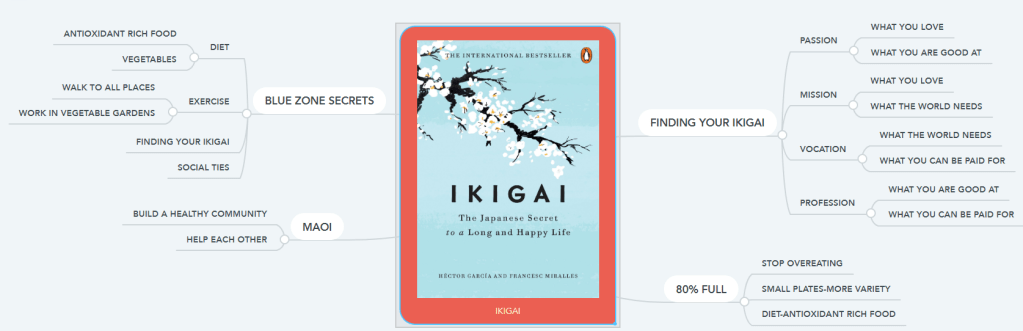
KEY TAKEAWAYS
- Find your Ikigai
- Blue Zones secret-Diet, Exercise, Ikigai and Social ties
- Fill your stomach only 80%- Small plates,more variety
- Form a community that nurtures you for life
MINDMAP OF THIS CHAPTER
Conclusion
This is a summary of the first chapter of the book Ikigai. I am doing a summary of every chapter. So stay tuned to Mommy Returns.
- Ayurvedic weight loss remedy
- “This is that”-Deivathin Kural
- Home Decor Ideas
- That one spot in your body to cure all the diseases
- All about Shivaratri
 MommyReturns